By Aly Kamadia, Editor-In-Chief, iDose Magazine
Editor’s note: An accompanying newsletter introduces this piece.
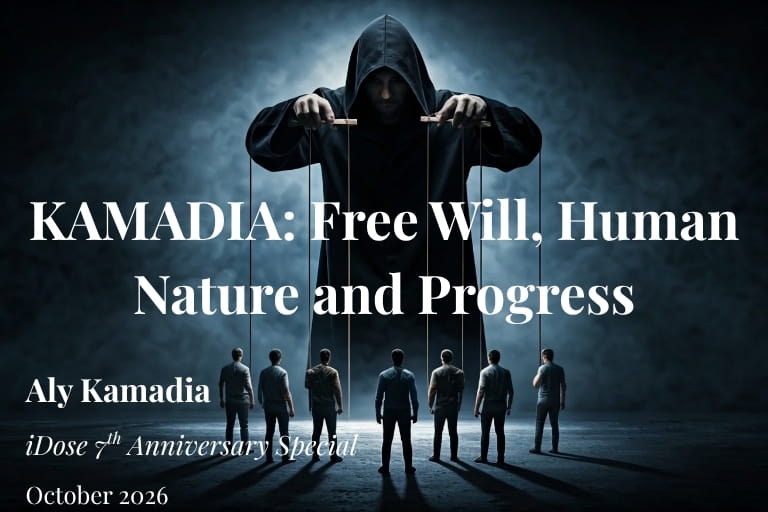
To say that “man is made in the image of God” is to level the harshest insult at the very same God.
Or is it?
I’m happy to weigh in on this and various philosophical topics, but first, allow me to offer some context.
Rewind to 2019, and having recently turned down some very generous PhD offers from a variety of Canada’s finest universities, I launched iDose Magazine as an experiment.
Publishing was collapsing and attention spans were shrinking, while deception and propaganda were thriving. Given this climate, I wanted to play my small part in countering propaganda but lacked the slightest interest in mediums that were skyrocketing into fashion: podcasts and short videos.
The thought of becoming an online ‘influencer’ horrified me.
Despite this aversion, I was always comfortable with the written word and acutely aware of its unique power.
And thus, armed with a few email lists and an entrepreneurial skill set, I sent a few weeks of intellectual doses out into the world to see how many readers might engage.
Seven years later, iDose readership has grown well beyond what I expected. From people seeking practical health education, to policymakers feeding on the minds of some of the world’s most distinguished thought leaders, the results of this experiment have been fantastic.
That said, as you can imagine, after seven years of iDose, and many more years engaging with serious intellectual discourse, my views have changed in certain ways—three of which I will share today.
Unlike typical iDose articles, I cannot emphasize enough that this piece is a window into my thinking; it presents conclusions without any serious arguments.
To what degree they reflect any wisdom is for you to judge.
Free Will vs Determinism
The age-old philosophical debate remains fascinating to many: Can humans genuinely choose between different actions, what is known as ‘free will’? Or are human choices strictly the product of forces (or variables) outside their control (earlier events, biology, overwhelming cognitive processes at the unconscious level, etc.), as the staunchest determinists assert? They also argue that to the extent one is convinced they are acting freely, that person is experiencing nothing more than a delusion.
Where do I land?
If you were to ask for my opinion when I was a graduate student, I would have highlighted that while many things are determined and outside of our control, humans still have much more free will than the staunchest determinists permit. If forced to choose which of the two forces is stronger, I’d easily go with free will.
Fast forward to 2019, when I was launching iDose, and I would have told you that my graduate school view was naïve. After carefully examining history, current affairs, and human behavior, it became clear to me that we, and our ‘choices,’ are far more determined than we like to believe.

Jumping past 2019 and into the current moment, one discovers a bit of a twist in my thinking.
While I still subscribe to this general posture (i.e., more determinism than free will), I no longer believe that a uniform or approximately uniform nature applies to our species. Put differently, there are individual differences among us insofar as the capacity for free will is concerned.
My current opinion is that a relatively small number of human beings exercise a high degree of free will, while most remain comforted by the delusion that they do; their lives are ruled by determinism.
If the reader accuses me of holding an ‘elitist’ conclusion, I am most certainly guilty.
But it is nevertheless my sincere opinion.
Enlightened Human Beings
Step back with me once more to my graduate school days, and if asked what I thought about human enlightenment, I would have stated the following:
Despite my plans to get a PhD, I do not think a person needs to be formally educated to live a perfectly happy and dignified life. But I do believe that a unique sense of enlightenment is achieved through the right type of intellectual inquiry. And I think this sort of enlightenment is reserved only for human beings.
Fast forward to 2019, when launching iDose Magazine, and I was already seriously doubting this belief held during graduate school.
In 2026, while I still believe that there is a rare sense of intellectual enlightenment that humans are capable of achieving, my mind condemns the utterly simplistic view of animals that I once harbored.
On one hand, humans are the most intelligent creatures on this planet (at least, on balance), with some advanced capabilities not found among animals.
On the other hand, contemporary science and direct experience make it abundantly clear to me that the inner lives of animals are proving to be extremely rich.
I not only speculate that many animals have emotions that run deep (many scientists would state that this is no longer speculation), and that some exercise fascinating types of intelligence and imagination, but I’m convinced that some (if not many) also have what we not-so-special humans refer to as consciousness—even though its nature may be different than human consciousness.
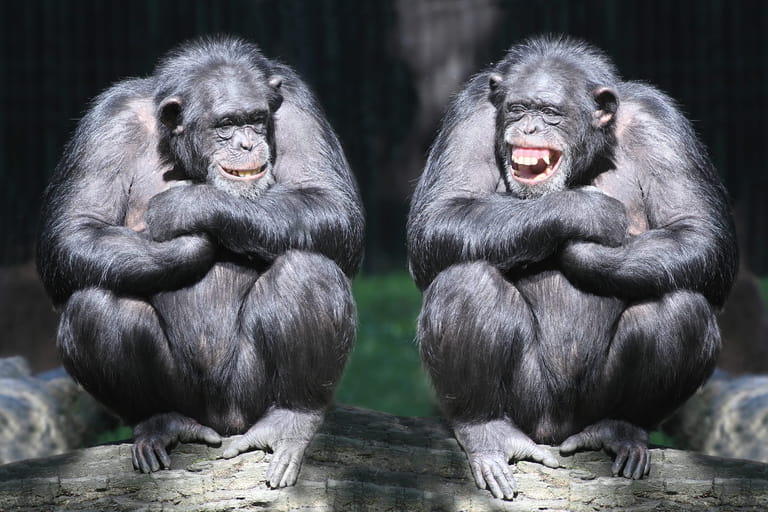
But it is on ethics and morality that the case for human specialness collapses most completely. Here, the purported stark distinction between humans and animals no longer sounds convincing.
If we study just a bit of our history, and follow human affairs in a way that is free of propaganda, I believe we can only conclude that our species not only has the capacity to commit the most unspeakable evils, but has a tendency to do so if various scenarios present themselves.
Thus, we aren’t above the ‘animal kingdom’. We are part of it.
With this in mind, when one states in isolation that “man is made in the image of God”, my reaction is laced with more than a small dose of confusion: Why are you insulting the very God that you believe in with no mercy?
Human Progress
One of the most powerful narratives to ever grip the human mind has been the idea that we are constantly progressing. Even if much slower than would be ideal, humanity is constantly progressing towards a higher degree of perfection—a state we will inevitably reach.
And so one comes across silly books such as Steven Pinker’s Enlightenment Now, which offer overly optimistic narratives of steady human progress (for a devastating critique that embarrasses Pinker, see work by British philosopher John Gray).
It’s perhaps not too surprising for readers at this point to hear that while I believe scientific and technological progress is highly likely to continue, political and moral progress is neither linear nor inevitable.
After all, the second opinion I presented to you was that our species is capable of, and has the tendency to commit, all sorts of barbarism in various scenarios. Anyone who doubts this is free to explore human history, or current affairs, where we discover many of the most powerful actors exercising all sorts of evils-often with the help of cutting edge science and technology.
Given my view that our very nature has the capacity and tendency to commit the most horrific actions, why would I hold the view that we are inevitably moving towards sustained and higher moral and political progress?
I can’t deny being reminded of Martin Luther King Jr.’s famous pronouncement: “The arc of the moral universe is long, but it bends toward justice.” These powerful words make for solid political rhetoric.

They pull on our heartstrings defined by morality, hope, and love. They are precisely what activists need to hear when trying to fashion a world that is a little better. It’s no stretch to say that the belief that ultimate justice will rule our planet one day is beautiful.
But that does not save this beautiful belief from being, in my humble view, downright delusional. After all, what rational justification do we have for believing this is even a plausible scenario?
All this raises an obvious question: if I am so skeptical of human freedom, human exceptionalism, and inevitable progress, why iDose? Why devote myself to disseminating serious intellectual thought?
The two answers are simple.
First, those who enjoy intellectual entertainment for its own sake are always welcome.
Second, and perhaps more importantly, I may not believe that we are masters of our own fate, uniquely enlightened creatures, or inevitably headed toward heaven on earth. But millions of people are still devoted to making themselves and/or the world, however modestly, better than it is.
And insofar as they can act, they deserve a clearer view of the world they are trying to improve. One less distorted by the fog of propaganda, deception, and simplistic narratives.
That is what iDose has always tried to offer.
Not false hope.
No BS.
But a small intellectual resource for those willing to risk detaching themselves from comforting illusions.
I hope our readers found the first seven years as fun as I did.
And cheers to the next seven, assuming that our favorite LLMs don’t swallow up human writing altogether.
© All Rights Reserved
Aly Kamadia is Editor-In-Chief of iDose Magazine. He currently serves as Director of Kamadia & Associates, and holds an Honors BA & MA in Political Science, both from the University of Waterloo, Canada. To read selected articles by Kamadia, click here.

Pingback: iDose Seventh Anniversary Newsletter: Kamadia talks philosophy - iDOSE