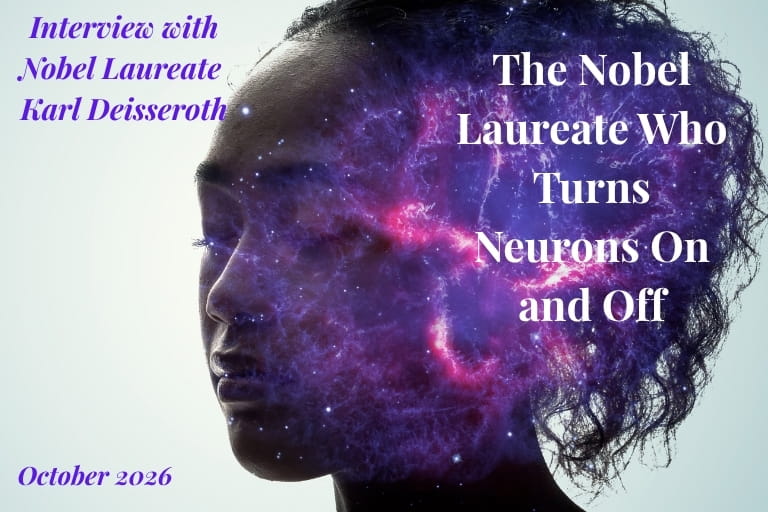
Interview with Karl Deisseroth, 2026 Nobel laureate in Physiology or Medicine and Stanford neuroscientist and psychiatrist, by Herlinde Koelbl, German photographic artist, author, and documentary filmmaker
What makes a brilliant scientist? Who are the people behind the greatest discoveries of our time? Connecting art and science, photographer Herlinde Koelbl seeks the answers in her book “Fascination of Science,” an indelible collection of portraits of and interviews with 60 pioneering scientists of the 21st century. Koelbl’s approach is intimate and accessible, and her highly personal interviews reveal the forces (as well as the personal quirks) that motivate the scientists’ work.
“I wanted to know how they think and with what insights they influence our lives, our future,” writes Koelbl in the book’s preface. “To this end, I traveled halfway around the world to ‘research’ these top scientists and to pass on their fascinating scientific results and life experiences — in other words, to bring science to life.”
The following conversation with neuroscientist Karl Deisseroth was conducted in 2020. Last week, Deisseroth was awarded the 2026 Nobel Prize in Physiology or Medicine, alongside Peter Hegemann and George Nagel.
Professor Deisseroth, when did you discover you had an unusual brain?
Every brain is unusual. My own unusualness has stood out a couple of times, though. I have a close connection to words. For me, it’s easy to read words rapidly and remember them. I remember once in fifth grade we were given around forty-five minutes to memorize a poem. I looked at the poem, and within a few seconds I raised my hand and said, “I’m ready.” When I got up there and recited the poem, the teacher thought, Well, that can’t be. He must have known that one already. So, she gave me another poem and, again, I memorized it almost immediately.
That’s remarkable. What’s your secret?
There may be a visual aspect to it. I tend to group words. In the same way many people can read a word or a phrase instantaneously, I can do longer chunks virtually instantaneously in a block. But it also helps that I feel so strongly about words. Feeling is part of memory, and memory is part of feeling. There’s no reason to remember something unless it causes a feeling. I think that helps make the words memorable.
I once heard a story about a conference you attended. While the speaker was giving his speech, which you listened to, you also managed to read two of his books. True?
We think we’re only aware of a single thing at once. There’s this unitary aspect to consciousness, but it doesn’t mean we can’t process many things in parallel, even if we are only conscious of one thing at a time. I think many physicians become good at processing things in parallel, running many different streams of thought simultaneously. There are moments when you’re on call, and there are multiple emergencies that all require your attention and engagement at the same time.
Dr. Deisseroth, when you first got into science, what did you hope to accomplish?
At first, I was trying to understand where feelings came from. This might be one of the deepest questions we may consider as human beings: How is it possible for an object to have an internal subjective sense, to have feelings? In some ways, this (perhaps unanswerable) question is still guiding me.
Weren’t you the first person to make the brain transparent?
We developed hydrogel-tissue chemistry, a technique in which we build hydrogels inside the cells of tissues. This means we made gels part of the brain tissue. The technology allows us to reach into the brain while keeping it intact, and we can see with incredible detail all the molecules and cells that make up the entire system.
You also made it possible, for the first time, to turn nerve cells on and off?
Right. That’s a technology called optogenetics. It allows us to use light to turn brain cells — neurons — on or off by using light. A lot of people think about light as a way to collect information about something. Take microscopes or telescopes, for instance. They use light to collect information about the world. But optogenetics is the opposite. We use light to control biology, to put information in the brain and make things happen.
How does that work?
We take genes — very special bits of DNA — from algae, plants, or bacteria. These genes encode proteins that turn light into electricity. The proteins then absorb photons — light particles — and allow the charged particles, or ions, to flow across the surface of a cell. We take those bits of DNA and put them into the brains of animals. The neurons then start to make these proteins, which are light-activated regulators of ion flow. We can even tell some cells to make the proteins and others not to make them. This gives us great power, because only the cells that have the gene will be turned on or off by the light.
And what good is this?
It’s a discovery tool. It’s a way of probing the brain to understand how it works. We’re learning which cells do what, how contradictions are resolved, where positive or negative feelings are situated. We’ve gotten ultra-high-resolution crystal structures of these proteins, so we can see every atom in its place. You can ask simple questions that you were never able to ask before. You know, “What does this cell do?” “What does this kind of cell do?” “How does this cell talk to that cell?” “How does it actually affect behavior?”
That’s up until now. Where are things headed?
I think we’ll see increasingly complex behavior studies. We can already test any aspect of mammalian or other animal behavior. In the future, we’ll see ideas for new kinds of medical treatment. Once you understand how a system works, then everything becomes more precise. Once you know what causes a symptom, which is what optogenetics gives you, then you can design any kind of intervention or therapy.
Am I wrong in thinking that this could lend itself to abuse, such as mind control?
Even if we wanted to misuse it, we’d first have to know a lot more about the brain than we do at present. Right now, it’s not a pressing issue because nobody is trying to do this sort of thing with human beings, but it’s something we need to be mindful of. Could people one day be modified in such a way that changes their proclivities, capabilities, or priorities? It’s theoretically possible. We do it with animals all the time. We can change anything we want to about what an animal wants to do or what it does.
When you were a graduate student, besides neuroscience and medicine, you took classes in fiction writing. What sparked that interest?
I wrote as a child and a teenager, and I joined writing clubs early on. In college, I also took writing courses. At the time, I still thought I would eventually become a writer. Even in graduate school and beyond, I went to a local community college and took writing courses. It’s been a theme all through my life. It’s a passion. With everything else going on, it would have to be a passion for me to find that much time for it.
Why are stories so important?
That’s how human beings understand and relate to one another. My goal is to tell the optogenetics story, for example. It’s a story of things that anyone can relate to: light and plants and feelings. It teaches people about the value of basic science, of understanding everything about our world for its own sake and everything that can come from that: the unexpected, the powerful, the transformative.
Do you see science and art as connected in any way?
Science and art are particularly connected, I think, through the brain. Just think about the feelings that words—artistic words—can stir in people. All that happens through the cells. The brain somehow turns art and words into feelings. In some ways, that’s the essence of neuroscience. It’s also the essence of art.
You remember many, many things. You must be absolutely brimming with emotion?
Early on, when I was teaching, I would be criticized for not being animated enough, that I wasn’t jumping around the classroom enough. The students wanted to see more emotion. That was hard for me, though, because I had trained myself to be so stable. In much of my life, I play the role of psychiatrist, teacher, and professor. These are not traditionally emotional roles, right? They are roles in which it’s actually better to be more of a blank slate, a solid rock.
Why do you continue to work as a psychiatrist?
Being a psychiatrist is part of my identity; it’s part of who I am. I like hearing people’s stories. I like helping them. I help reduce their suffering. It’s just part of who I am.
In addition to your work as a psychiatrist, you’re a teacher and a professor, are married, and have five children. You also travel a lot for work and your wife is a very successful scientist herself. How do you do it all?
My wife is an extremely successful scientist. She’s also an MD-PhD and a serious clinician. She runs a pioneering laboratory as well, and travels all around the world. Of course, there are always things that go wrong. It’s not like we don’t have our defeats and our disasters. But when something goes wrong in one domain, we still have other domains that fulfill us.
Many scientists — mostly men, of course — tell me it’s not feasible for a woman to be at the top of the science world and to also have kids. But your wife seems to manage just fine, right?
Full credit to my wife. She is an amazing person. She is absolutely at the top of her field and an extremely creative and productive scientist, and we’ve got five kids at home.
Any advice for young female scientists who would like to one day start a family?
I don’t feel as though I’m the one who necessarily can give direct advice to young women scientists, except to say that it’s definitely possible to make it all work. My wife’s experience, I think, makes that clear. I think you need to be certain about what you need and what you want in life, and what you want from your partner, and be able to adapt to each other. Also, different rules work for different couples. I think it just requires honest communication and good planning.
When did you stumble onto your path to success?
In the beginning, people would see what we were trying to do and say things like, “This isn’t going to work,” or, “There are about ten different things that you’d have to solve and many of them are almost unsolvable.” I didn’t have an answer, so it was a stressful time before we were able to solve these other issues and make the whole thing work.
How bad was it?
I had physical symptoms during those first five years. I had sort of an illness, a nausea that persisted almost every day because of the tension and stress. I wasn’t in a particularly great place. It was a challenging time.
What kept you going?
The hope and belief that what we were doing would matter. When life has brought you to a place where you can do something that matters, it’s a privilege. It’s not to be taken lightly. I knew this work was something that could be important for humanity. It was more like a responsibility to see what was possible. It took about five years of very serious stress to make it happen, but during that time the idea was that this was my calling. This was where life had brought me.
Was there a eureka moment for you when things finally started to work?
The clearest moment was in 2007. A PhD student in my lab did an experiment in which he put one of these bits of DNA into the right part of a mouse’s brain — the part that controls movement. As soon as we turned on the light, the mouse moved. When we turned off the light, it stopped. It was incredible. Not only were we using light and plant DNA to precisely control mammalian behavior, but also this experiment addressed in one fell swoop most of the questions and concerns people had raised about the project.
What’s the most fascinating thing about being a neuroscientist?
Well, science is, in some ways, the root to a deeper understanding of everything — literature, art, history, law. This is especially true for neuroscience. We’ve already seen what it’s done for computer science. The current revolution in deep learning and machine learning absolutely has its roots in neuroscience. It has changed every aspect of the world we live in.
Do you have any advice for young people considering a career in science?
It wouldn’t hurt to have a perspective on the human brain and on neuroscience going forward. But I would also encourage people to take more risks. If you’re doing work that’s high risk, it’s liberating. It’s easier when there aren’t expectations that things have to turn out in a particular way, or that the work will be productive on a certain time scale. In some ways, there’s more pressure if you’re doing something predictable because then it darn well had better work.
What kind of routine should young people have?
It’s important to take breaks, to not work too hard, and to reset yourself, to have time in each day when you let yourself think deeply. We all have emergencies that occur, but you need to carve out time each day — at least an hour — when you can get to the bottom of things. That’s vital.
When do you do your best thinking?
I have to be in a quiet environment, where my body is still, where ideally the room is windowless. It doesn’t have to be dark, but it’s best if things aren’t changing in the world around me. It lets me enter a meditative state, where my mind can focus and go deep into questions.
Speaking of isolation, were you an outsider when you were young?
I was, yeah. I was a little introverted. I’m in good company; many scientists were not exactly the most socially popular kids when they were growing up. I was also much smaller than other kids in my class, since I was effectively two years younger than everybody else. That creates a separating influence. That probably made me live outside the mainstream for a while.
Have you ever been part of the mainstream?
Well, you don’t always want to be outside the mainstream when you’re a doctor. You want patients to get at least the standard of care. So, in that part of my life, yes. In other parts, probably not.
Do you think being an outsider makes you a better scientist?
I think being a bit of an outsider is maybe part of being a good scientist. If science is about new discoveries, that means you’re going beyond the current paradigm. You have to be comfortable with that. It requires a certain impatience with the current paradigm, the current set of knowledge.
What is your message to the world?
One message is that we are living in a unique time. We are about to discover things about the world and about ourselves that will only be discovered once and that are very deep. This is a time when all people should be excited about discovery because it’s happening in ways that will forever affect the human journey. We should all see the excitement and beauty in that.
Karl Deisseroth is a professor of bioengineering and of psychiatry and behavioral sciences at Stanford University. He was awarded the 2026 Nobel Prize in Physiology or Medicine, alongside Peter Hegemann and George Nagel.
Herlinde Koelbl is a German photographic artist, author, and documentary filmmaker. She has published more than a dozen photography books and has received numerous awards for her work, including the Dr. Erich Salomon Prize in 2001. You can learn more about her at www.herlindekoelbl.com. This interview is excerpted from her book “Fascination of Science.”
Note: The views expressed in this article belong to the participants, and do not reflect the position of Intellectual Dose, or iDose (its online publication). This article is republished from The MIT Press Reader with permission