By Nick Anstead, Associate Professor, Department of Media and Communications at the London School of Economics
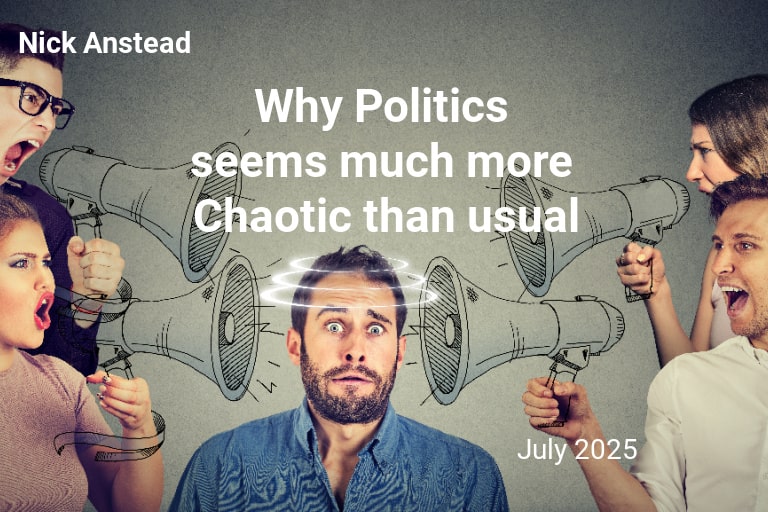
Politics can feel very chaotic these days, and the news cycle like a never ending crisis. Nick Anstead argues that a big reason for that is a communications strategy inspired by First World War battleship camouflage, and adopted by the likes of Donald Trump.
Modern politics sometimes feels as if it is taking place in fast-forward. One crisis leads to another, and even very significant news stories are rapidly superseded in a seemingly accelerating news cycle. Why does contemporary politics feel like this? In part, the reasons are structural, with politics being shaped by the material, social and communicative environment in which it is taking place. Due to these instabilities, some scholars have argued we now live in the age of crisis, or even a permacrisis. However, beyond these structural reasons, it also seems fair to argue that the frantic and chaotic character of modern politics is the result of strategic decisions taken by some politicians and their advisors, the most obvious example being Donald Trump.
The small target strategy
Trump’s electoral success in using this mode of communication poses a puzzle for academic political scientists of my generation. I completed my PhD in 2009, and therefore was still drawing heavily on literature shaped by the successful political communication practices of Bill Clinton and Tony Blair from the 1990s and early 2000s. This model of campaigning enshrined ideas like professionalism, message discipline and the idea that no Minister could survive a prolonged tabloid feeding frenzy (although it is worth noting that Alastair Campbell, the supposed author of this rule, has no recollection of actually saying it). Trump seems to ignore all these principles, yet is still electorally hugely successful.
To address this contradiction, it is worth employing a historical metaphor: the use and development of camouflage during the First World War. At the start of the twentieth century, many countries were still using military uniforms which would not have looked out of place in the Napoleonic Era. The French even went to war in 1914 still sporting the famous Pantalon rouge. However, it very soon became clear that bright uniforms in an era of modern industrial warfare left soldiers hopelessly exposed. Armies adopted drabber colours, in the hope that they would make troops harder to spot on the battlefield.
The contemporary political communications equivalent of this type of military uniform is what is sometimes termed “small target” campaigning. It is in many ways the direct descendent of the message discipline practiced by the Clinton Democrats and New Labour in the 1990s. The term “small target” comes from Australia and rose to particular prominence in the 2022 Federal election. The opposition Labor Party, led by Anthony Albanese, consciously set out to avoid saying anything which might generate negative coverage. In practical terms, this meant avoiding big ideological pronouncements, a relatively limited policy offer, a heavy focus on what the party would not do, and very careful management of contact with the media. The strategy worked, and Labor won sufficient seats in the election to form a majority government. For those familiar with UK politics, small target campaigning probably sounds familiar, as it is very reminiscent of the approach taken by Keir Starmer’s Labour prior to the 2024 election.
The Donald Trump strategy
A different type of camouflage in the First World War helps us understand Donald Trump’s chaotic political communication style. From the early months of the war a fierce debate raged which drew in admirals, artists and zoologists. The question being discussed was: how do you paint a ship to make it safe, particularly from the new threat of submarines? The most famous solution to this problem was dazzle (or razzle-dazzle in the United States).
The aim of dazzle was not to conceal ships, but instead to disorientate pursuers. Dazzle consisted of patterns, lines and geometric shapes painted onto ships to disrupt the structural outline of a vessel. This mattered because a U-boat captain would need to aim a torpedo not directly at a ship, but instead at a point in the water where the ship would be when the torpedo arrived. This meant estimating the speed, heading and range to a target was vital to a successful attack, and inaccuracies would render the submarine’s weapons harmless.
How does this help us understand Donald Trump’s chaotic communication style? Famously, Trump’s adviser Steve Bannon said that the goal of political communication was to “flood the zone with shit.” In other words, push out so much content that political opponent and the media are overwhelmed, and disorientated. This is the Trump version of dazzle, making it hard for his opponents to develop a cogent attack line.
Consider the first week of Trump’s second term as President. During that time, Trump signed no fewer than 36 Executive Orders, covering areas as diverse as free speech rights, ending DEI programs, creating DOGE, renaming the Gulf of Mexico, and declassifying documents related to the JFK assassination. The sheer speed and range of Executive Orders coming from the White House gave a Democrats a huge strategic dilemma. At the end of the week, The Washington Post reported:
“Some [Democratic] lawmakers feel passionate about responding to every rollback Trump has unilaterally enacted… Others believe they should remain focused and respond more strategically, fearing that voters will again become numb to Democrats’ fire-alarm responses to Trump’s every move”.
Faced by Trump’s scattergun message approach, opponents must decide if they will attempt to match his frantic levels of communication or instead focus on a few specific issues. For this reason then, Trump’s style might appear chaotic but have no doubt: there is a method behind the approach. For political journalists and ordinary citizens, the dazzle political communication strategy poses huge challenges. The best response is to try to avoid being sucked into daily (or even hourly) news cycles, and to try to remain focused on issues that are the most politically salient.
Nick Anstead is Associate Professor in the Department of Media and Communications at London School of Economics
Note: The views expressed in this article belong to the author, and do not reflect the position of Intellectual Dose, or iDose (its online publication). This article is republished from the LSE USAPP under a Creative Commons license