By Lee Cronk, Distinguished Professor of Anthropology, Rutgers University
The motto of the UK’s Royal Navy is “Si vis pacem, para bellum.” Translated from Latin, that means “If you wish for peace, prepare for war.” That is good advice.
How can war best be prevented?
Of all the threats that exist to freedom and prosperity, war is the greatest. It destroys not only the lives of innocent people but also their property and livelihoods. In addition, research has shown that wars provide an excuse for governments to grow larger and more powerful, not just during wartime but, thanks to a ratchet effect, permanently. Given how bad wars are for people’s rights and liberty, the question becomes not how best to wage them but how to make them as unlikely as possible.
There are at least three ways to accomplish that goal. The first is diplomacy. Negotiating with potential adversaries is always the best first step when hostilities seem imminent.
The second is maintaining defensive alliances with like-minded nations. Such alliances deter wars by sending a clear signal to potential adversaries that an attack on one of them will be considered an attack on all of them. NATO is a good example of such an alliance. It has also been remarkably successful. During the nearly eighty years since it was founded, no nation has ever used its military to attack a NATO member in the region covered by its charter (roughly, the territories of its European and North American members, the territory of Türkiye, and its members’ possessions in the North Atlantic).
The third is maintaining a strong defensive military. A strong defence convinces potential adversaries that any war with your nation would be too costly and too unlikely to succeed to be worthwhile. But what you don’t want is a military that is focused more on offense than defence, because that will increase rather than decrease the likelihood of war.
Misunderstanding the role of a defensive military
Consider this analogy: a nation’s military is like a fire extinguisher. You keep a fire extinguisher in your kitchen because you are prudent, not because you want to actually use it. After all, the only circumstances in which you would have to use the fire extinguisher would be disastrous. Similarly, we maintain a defensive military not because we want to use it to wage war but to prevent wars from starting in the first place.
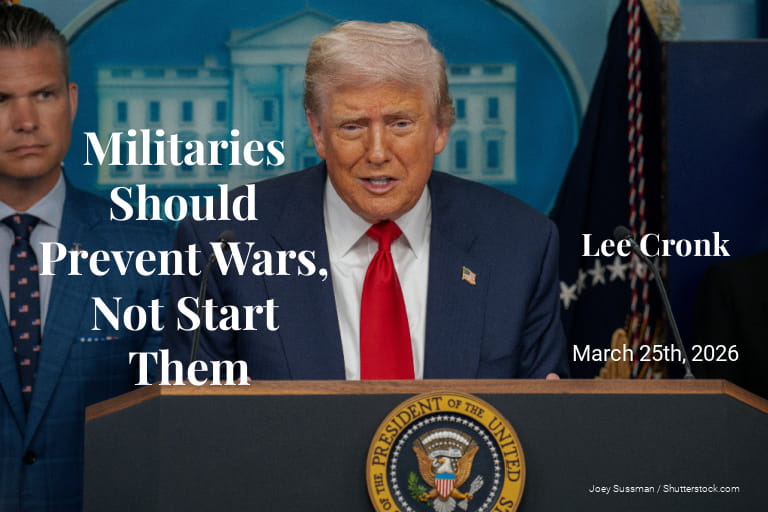
Unfortunately, US President Donald J. Trump and members of his administration, in particular Secretary of Defense Pete Hegseth, do not seem to understand this. Their misunderstanding is on display almost daily in the rhetoric they use to describe the US military, its members, and the war it is now waging against Iran.
Take, for example, their desire to rename the Department of Defense as the Department of War. That alone speaks volumes about how they see the role of the US military: to wage war, not to prevent it by defending the US and its allies.
Or consider the fact that the Trump administration chose to brand the attacks on Iran not in morally righteous terms, as was the case with previous military operations, such as the war in Afghanistan (“Operation Enduring Freedom”) but rather in terms of violence and rage: Operation Epic Fury.
More specific examples of Trump and Hegseth’s bellicose rhetoric are easy to find. Hegseth, for example, prefers calling American soldiers “warfighters.” He refers to rules of engagement that limit what soldiers can do as “stupid.” He promises that the US military will rain “death and destruction from the sky all day long.” Two of his favourite rhyming catchphrases are “Maximum lethality, not tepid legality” and “Violent effect, not politically correct.” And, under Trump and Hegseth’s leadership, the Pentagon has released videos on social media that use images from popular culture to glorify the war and make it seem as inconsequential as a violent video game.
The American public does not favour this war of choice
Fortunately, the majority of Americans are not enthusiastic about the way Trump and Hegseth are using the US military. While most Americans supported US involvement in World War II, the Korean War, the Persian Gulf War, the war in Afghanistan, and the Iraq War, only 41 percent of Americans support the attacks on Iran. As the price of gasoline increases and American deaths accumulate, that number is likely to shrink.
Future administrations will do well to heed the Royal Navy’s sage advice, with an additional embellishment: If you wish for peace, prepare for war, but do not engage in war on a whim. “Wars of choice,” as the attacks on Iran have often been described, should not exist.
Lee Cronk is a Distinguished Professor in the Department of Anthropology at Rutgers University
Note: The views expressed in this article belong to the author, and do not reflect the position of Intellectual Dose, or iDose Magazine (its online publication). This article is republished from LSE USAPP under a Creative Commons license