
Is Earth the only planet in the Universe harboring intelligent life? In the following interview, iDose Magazine Editor-in-Chief Aly Kamadia speaks to astrophysicist and Professor Jonti Horner of the University of Southern Queensland. The two discuss the search for intelligent life beyond Earth, the odds we’ll find it in our lifetime, and why the answer matters more than we think.
Aly Kamadia (AK): Thank you so much for the opportunity to interview you, Professor Horner.
Professor Jonti Horner (JH): I’m happy to be here — many thanks for giving me the opportunity to chat!
AK: Among the most fascinating topics in astronomy, perhaps the most exciting topic in popular culture, is whether intelligent life exists beyond Earth (extraterrestrial intelligence, ETI).
You’ve spent decades researching this question. How likely is it that intelligent life exists beyond Earth?
JH: This is really the million-dollar question!
At the moment, we only have one example of life in the Universe — that is life on Earth — and so all our speculation on life elsewhere is driven by that one data point. While we can imagine life that is vastly different from what we see here, which is a staple of science fiction, scientists tend to focus their thoughts on the kind that we know exists (i.e., life as it appears on Earth). Even with that narrower focus, with only one example to go on, our ideas about how common or rare life might be (and by extension, intelligent life) are currently very much educated guesses.
None of that answers the question, of course, but I think it’s important to give that qualification before I dive into my own speculation.
For me, it all boils down to a numbers game. Our galaxy contains roughly four hundred thousand million stars (four hundred billion) — though that estimate might be off by a factor of two or so. Thanks to discoveries we’ve made over the past three decades, we know that pretty much all stars have planets (a natural byproduct of star formation), meaning it’s likely that our galaxy contains trillions of planets (thousands of billions; or millions of millions).
And that’s just one galaxy.
Conservative estimates suggest that there are at least 200 billion galaxies in the observable Universe — each of which will be packed with trillions of planets of their own. This suggests that in the observable Universe, there will be something like a trillion trillion planets (something like 1,000,000,000,000,000,000,000,000 planets).
With so much real estate out there, I find it vanishingly unlikely that Earth is the only place with life.
If only one planet in one billion were to develop life throughout the cosmos, that would still leave a thousand trillion planets in the Universe with life. Even if only one in a billion of those develops intelligent life, we are still left with one million planets that have intelligent life.
So, the idea that we are alone in the Universe just seems extremely improbable to me. The real question is whether life is sufficiently common in the cosmos to be close enough to detect. That’s a harder one to answer. But I strongly suspect that how soon we find life elsewhere will tell us a lot about how common it is in the cosmos.
AK: I don’t think the human mind is built to fully appreciate just how large these numbers you’re referencing are — though phrases like “trillion trillion” certainly help.
You say that in just our galaxy, there may be “trillions” of planets. Well, let’s suppose a hypothetical number of 2 trillion, and ask the reader a simple question:
If you had to count each planet, and it took one second to count each one, how long would it take you to reach 2 trillion (i.e., the number of planets in only our galaxy)?
The answer?
Roughly 62,000 years!

And yet, despite numbers hinting that the cosmos should be abundant with life (and intelligent life), the popularized version of the Fermi Paradox haunts us: “Where is everybody?” Why do we see no evidence?
There has been no shortage of answers attempting to address the “Where is everybody?” question. On one side of the spectrum are scholars who share your belief in ETI, and then those who reject the idea that intelligent life is out there.
Regarding the latter, in your estimation, what is the strongest argument that supports rejecting the possibility of ETI?
JH: I actually don’t think at the moment that there are really strong arguments supporting the lack of ETI — absence of evidence is not evidence of absence. These are questions that currently sit right at the boundary between philosophy and science. As long as we only have one example of life (i.e., Earth), the only thing we can definitely rule out is that the Universe is utterly devoid of life. We know that life got started at least once — so it’s clearly possible rather than impossible.
There are still good reasons to think we might never hear from intelligent aliens though — even if they are out there.
One key example is how, as our technology improves, we will be less vocal in shouting our own existence to the void.
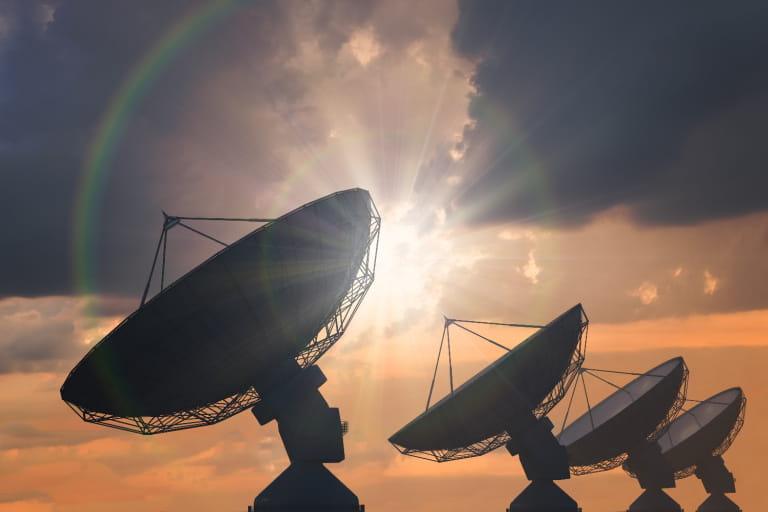
We’ve been broadcasting to the cosmos for almost a century. Some argue that the broadcasts of the Berlin Olympics in 1936 were the first signals loud enough to be heard from the stars, while others suggest the coronation of Queen Elizabeth in the 1950s was the point we hit that threshold. From then on, our radio and TV broadcasts were being transmitted in all directions, meaning that anyone around a nearby star, with a strong enough detector, could tune in and watch Seinfeld or The Simpsons.
As technology has moved forward, however, those omni-directional broadcasts are being replaced by methods of transmission that don’t leak into space. The football and cricket I watched earlier in the week came into my home through fiber-optic cable rather than being broadcast from a TV tower. And so, none of that signal ended up leaking into space.
It’s quite plausible that, within a few decades, our planet will become radio quiet again. If other species that reach our level of technology follow the same path, it makes sense that they’d have a very brief period of screaming their existence into the void before falling silent again.
As we look out to our neighboring stars, looking for signs of ETI, we are seeing them at an instant in their lives. The Sun-like stars we consider the most promising places to observe are, like our Sun, several billion years old. Life has been around on Earth for three or four billion years, and in all that time, our planet has only been broadcasting radio waves for less than a hundred years.
Imagine observing the Earth from around another star at a random moment in our planet’s history. You’d have only a one in forty million chance of catching us during the brief window in which humanity is broadcasting. Now flip that around: what are the odds that we happen to catch an inhabited planet around another star at precisely the brief moment its home species is shouting into the dark?
AK: Fair enough — you don’t find any of the arguments against ETI compelling. And you’ve illustrated, quite nicely I’d add, one possible scenario that explains why contact with ETI may be unlikely.
I’m mindful that we’re in highly speculative territory here, but I want to push you a bit further: for those like you who strongly believe in ETI, which arguments do you find most convincing when it comes to addressing “where are all the aliens?”
JH: Most likely, I tend to think there’s simply no reason to visit Earth.
About fifteen years ago, I was helping to teach a course on Astrobiology at the University of New South Wales, and an assessment asked students to write a short essay about whether aliens would be a threat to life on Earth. Most students, doubtless inspired by Hollywood movies featuring alien invasions, wrote about how aliens would come and plunder Earth — just as different cultures in Earth’s history traveled the seas and invaded far-off lands.

But one student wrote an essay whose central theme has stuck with me — I wish I still had a copy. She made a few fantastic points. First, the stars are incredibly far apart. When we talk about distances in light years, we are discussing how long it would take light, traveling at 300,000 km/s, to make the journey. Even traveling at the speed of our fastest spacecraft, reaching the nearest stars would take tens of thousands of years. Such a journey, even with more advanced technology, would require a huge investment of time and resources. So why would you go somewhere that is already claimed (i.e., Earth), when you could instead spend those resources going to places where there is no competition?
In addition, she wrote about how life that evolved on a different planet would be adapted to live on that planet — not on Earth. So, coming to Earth to take over would require them to plan to do their equivalent of terraforming — adapting Earth to be suitable to their needs. Why travel all the way to Earth to do that, when you could do the same to planets that don’t have life?
I really think the simplest answer to “where are all the aliens” is that, if there are intelligent aliens somewhere in the cosmos, they are so immeasurably distant from us that there is no motivation for them to attempt to travel here; no real reason to come say hi.
And it would be a really remarkable quirk of chance to have aliens first visiting the Solar system just at the moment we are finally advanced enough to notice them. While the British author Sir Terry Pratchett wrote that million-to-one chances crop up nine times out of ten, I think in this case the odds of aliens deciding to drop by in the near future would be far longer than a million to one.
AK: Part of your answer reminds me of what the Fermi paradox was probably really about.
In reviewing the academic literature, I was surprised that the heart of Fermi’s casual 1950s remark (“Where is everybody?”) had to do with the feasibility of interstellar travel (traveling to other stars), and not primarily the existence of extraterrestrial life.
That said, I want to conclude on a philosophical note.
Our history has revealed that we don’t occupy the center of the Universe. We discovered our species shares ancestors with every living thing on Earth. Along with recent science indicating that much of our thinking is done at an unconscious level (raising questions about the extent of free will we have), each revelation shrank our sense of cosmic importance — at least in the minds of many.
If we never make meaningful contact with extraterrestrial intelligence — if the silence from ETI continues — do you think humanity will be better off? Perhaps by not having our sense of cosmic meaning diminish even further?
JH: I think I’d never say never — if we don’t make contact in the next year, or the next decade, or the next millennium, that doesn’t mean that we never will.
Regardless of whether we discover alien life — intelligent or otherwise — humanity will continue to look out at the cosmos in wonder. We’ll explore, and move beyond Earth, and if we haven’t yet found that we’re not alone, we’ll continue to ask, “Are we alone?”
It’s asking these questions — wondering what it means to be human, and whether we are special and unique or just another intelligent species — that makes us what we are. It’s kind of fundamental to the human experience to wonder what lies over the next hill, or around the nearest star. And I don’t think finding life elsewhere would stop us from asking those questions. Equally, if we don’t find life, we’ll keep asking those questions and exploring.
After all, that’s what it means to be human.
Prof Jonti Horner is an astrobiologist at the University of Southern Queensland. He first became interested in astronomy at the age of five, and joined his local astronomy society in the UK, WYAS, three years later. He received his PhD from the University of Oxford in 2004, and worked as a researcher in Switzerland and the UK for several years, before moving to Australia in 2010. Horner is an enthusiastic and passionate science communicator, whose research focuses on the Solar system’s small bodies, the search for Exoplanets, and trying to answer the question ‘Are We Alone?’ You can read more of his popular science writing on his author profile at The Conversation.
Aly Kamadia is the Editor-in-Chief of iDose Magazine. He holds an Honors B.A. and M.A. in Political Science from the University of Waterloo in Canada. He currently serves as Vice President of the Royal Astronomical Society of Canada (Toronto Centre), having previously served as its Education and Public Outreach Chair. Additionally, he continues to serve as the Director of Kamadia & Associates.
© All Rights Reserved