By Gábor Szabó, Independent Political Scientist
The exhausted vocabulary of fascism
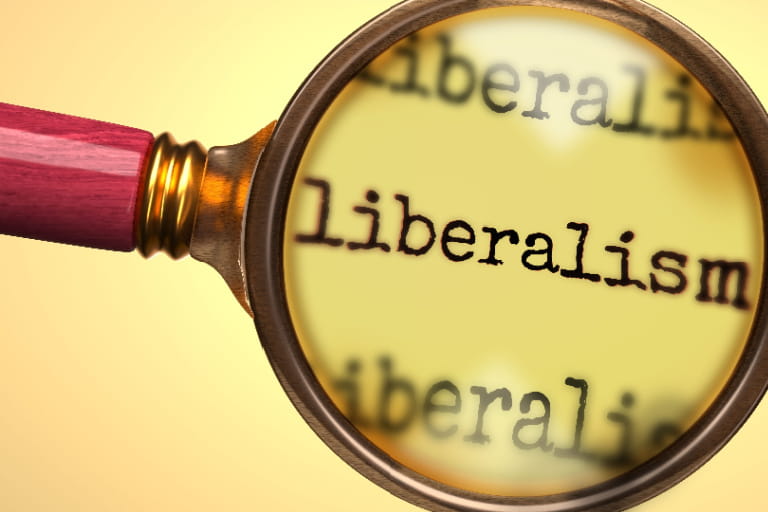
In the decade since the first Trump presidency, the charge of “fascism” has become both politically indispensable and analytically exhausted. From Timothy Snyder’s On Tyranny, Jason Stanley’s How Fascism Works, and Madeleine Albright’s Fascism: A Warning to a steady stream of magazine essays, the term has become the default liberal vocabulary for describing Trumpism, Modi’s India, Putin’s Russia, and beyond. Yet the more reflexively it circulates, the less analytical purchase it retains.
The book’s most provocative claim is not that Trump is a fascist, but that liberalism itself harbours the ideological and structural resources from which contemporary authoritarianism emerges
As Jake Scott noted on LSE Review of Books, Liberal Fascisms is the third volume in Žižek’s Bloomsbury trilogy of collected essays. It enters the fascism debate by turning the accusation back on the liberal centre that deploys it so readily. The book’s most provocative claim is not that Trump is a fascist, but that liberalism itself harbours the ideological and structural resources from which contemporary authoritarianism emerges. Žižek is not primarily arguing with right-wing intellectuals; he is confronting the liberal-democratic mainstream that has framed post-2016 discourse. His target is the comforting reflex that treats authoritarian developments as intrusions from outside the liberal world.
What is “liberal fascism”?
The title deliberately inverts Jonah Goldberg’s 2009 conservative polemic Liberal Fascism, which located fascism in American progressivism. Žižek’s counter-thesis is more unsettling: contemporary authoritarianism is not liberalism’s external adversary but one of its latent internal possibilities. Trump, on this view, embodies the “fascist liberal” – a figure in whom market absolutism, libertarian rhetoric, intensified state coercion, and emerging corporate-feudal power structures converge. The argument builds on a clear intellectual lineage, most notably Domenico Losurdo’s Liberalism: A Counter-History (2011), which documented the liberal tradition’s long entanglement with imperialism, racism, and exclusion. Where Losurdo provided historical and philosophical scaffolding, Žižek radicalises this insight for the present political moment.
Organised around a Hegelian triad of global predicament, regional turbulences, and Trump’s America, the book applies “liberal fascism” comparatively to regimes as varied as Modi’s India, Putin’s Russia, and Erdoğan’s Turkey. Enzo Traverso has argued in The New Faces of Fascism (2019) for the more cautious term “post-fascism,” precisely because these movements remain embedded within the neoliberal order rather than fully rupturing it. Žižek’s broader concept of “liberal fascism” captures the breadth of the crisis more effectively, though sometimes at the expense of analytical sharpness. At times, the term risks becoming less a delimited category than a charged interpretive atmosphere.
The title deliberately inverts Jonah Goldberg’s Liberal Fascism. Žižek’s counter-thesis is that contemporary authoritarianism is not liberalism’s external adversary but one of its internal possibilities. Trump becomes the “fascist liberal”: a figure who lets the market operate “at its most destructive” while treating ethical limits on sexism and racism as socialist constraints. Here, market freedom and coercive power converge rather than contradict one another.
Alberto Spektorowski approaches the same problem from the opposite direction. In Intellectual Post-fascism? (2025), he reconstructs a coherent and ideologically dense post-fascist formation around figures on the contemporary radical right. Both Spektorowski and Žižek refuse to treat contemporary authoritarianism as mere populist noise. But the direction of the argument is different. For Žižek, it is liberalism’s internal shadow: a possibility generated by liberalism’s own contradictions.
Žižek excels at diagnosing crisis and liberalism’s internal pathologies but is thinner on questions of political form and institutional design.
Žižek’s quarrel with the liberal-democratic left
The book’s most contentious element is not its diagnosis, but the political alternative it gestures toward. Žižek calls for a “realist utopia” involving a tacit coalition between a pragmatic conservative establishment and a new “Leninist elite” prepared to confront ecological, military, and technological catastrophes. This places him in a current of the left impatient with liberal-democratic proceduralism and open to exceptional forms of authority. The position is uneasy even on its own terms. Žižek sustains a critique of right-wing authoritarianism while invoking Alain Badiou’s defence of the political function of the Master – in The Impasses of Today’s Radical Politics (2014), he quotes Badiou’s claim that “one has to renew the position of the master,” before concluding that “a new figure of the Master is needed” – and sketching a politics of urgency in which even coercive measures may appear justified by existential stakes. (36.) He seeks to distinguish emancipatory authority from demagogic domination, yet the distinction is more often asserted than carefully elaborated.
Compared with Matt Sleat’s recent work, Post-Liberalism (2026), Žižek’s limitations become apparent. Sleat takes the critique of liberalism seriously while probing whether post-liberal thought can be institutionalised under conditions of deep pluralism. Appeals to the common good, Sleat notes, do not dissolve moral disagreement; they frequently displace it into struggles over authority and institutional control.
Žižek excels at diagnosing crisis and liberalism’s internal pathologies but is thinner on questions of political form and institutional design. His endorsement of New York’s new mayor Zohran Mamdani as a model of “heresy that can work” is therefore striking – and somewhat at odds with the broader thrust. Žižek’s point is that the contemporary Left has so far failed to stage a genuinely heretical break with global neoliberalism; disturbingly, he suggests, it was Trump who enacted such a rupture from the right. Yet Mamdani exemplifies patient, democratic-socialist coalition-building within liberal institutions, while the “Leninist elite” evokes something closer to vanguardist rupture. The book does not fully reconcile these visions, leaving readers to discern which Žižek ultimately privileges.
Žižek insists that the most disturbing possibilities of our time are not alien intrusions but futures already gestating within liberalism’s contradictions.
Žižek diagnoses liberalism’s drift toward authoritarianism more incisively than he charts a convincing path beyond it. That, ultimately, marks both the book’s achievement and its limit. Few contemporary thinkers refuse the comforting binary between liberal democracy and its supposed external enemies as resolutely as Žižek. He insists that the most disturbing possibilities of our time are not alien intrusions but futures already gestating within liberalism’s contradictions. Yet forcing the debate onto this harder ground is itself a significant contribution – one Žižek, characteristically, makes with intellectual force and stylistic verve.
Gábor Szabó is an independent political scientist working on modern European history, political discourse and historical memory. His current research examines legitimacy, authoritarianism and the political languages of crisis in twentieth-century Europe.
Note: The views expressed in this article belong to the author, and do not reflect the position of Intellectual Dose, or iDose (its online publication). This article is republished from LSE Review of Book under a Creative Commons license