By Elaine Coburn, Professor of International Studies, York University
Stinking Rich by scholar Carl Rhodes and The Haves and Have-Yachts by journalist Evan Osnos examine billionaires and show how their power and influence undermines democracy. Elaine Coburn writes that, as the Epstein files put the spotlight on bad billionaire behaviour, these two books are a stark reminder of why extreme wealth accumulation is dangerous, in and of itself.
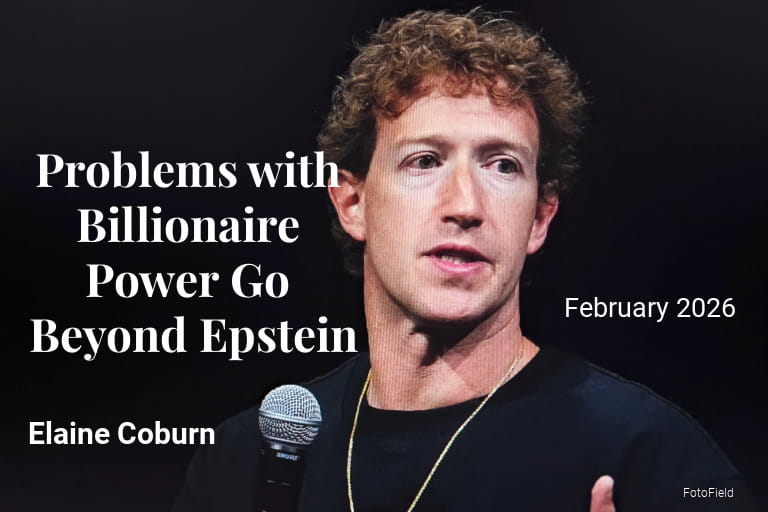
We have a billionaire problem. The release of the latest tranche of the Epstein Files in late January 2026 has shaken the world. Though the depraved nature of Epstein’s sexual exploitation of girls and young women was already well known, the disturbing details and vastness of the network of people involved in these crimes, whose wealth and power insulated them from consequences and criminal charges, is difficult to digest. Epstein used his vast personal fortune to bend democracy, and he is rightly reviled for actions that United Nations’ experts suggest may amount to crimes against humanity.
There is a risk that the power concentrated in Epstein’s hands will be seen as dangerous only because he and those who sought his favour were depraved […] deflect[ing] from the reality that accumulating such extreme wealth and power is, in and of itself, dangerous
There is a risk, however, that the power concentrated in Epstein’s hands will be seen as dangerous only because he and those who sought his favour were depraved. Such a framing deflects from the reality that accumulating that level of wealth and power is, in and of itself, dangerous to democracy. It fundamentally erodes decision-making by and for the people. Against this backdrop, two timely, well-written books examine the lives of today’s very rich, the myths that surround them, and the power they wield. If Epstein’s crimes are rightly condemned, both authors remind us that political outrage and mobilisation is necessary to challenge the real billionaire problem: their outsized influence in every aspect of life.
Debunking myths about billionaires
In Stinking Rich: The Four Myths of the Good Billionaire Carl Rhodes, the Dean of the University of Technology Sydney’s Business School, argues that there is widespread respect, even awe for the wealthy (50), while the poor are scorned for failing to “dream hard enough” (51). In today’s culture, Rhodes argues that four major myths about the billionaire dominate, each of which must be challenged as part of a broader political project to limit wealth inequalities and strive for a more equal world.
First, he critiques the closely allied celebrations of the “heroic” and self-made billionaire that claims inequalities are earned through the hard work of the talented few. Inherited wealth, he observes, enables the rich to take chances and so become even richer. In 2019, Forbes magazine celebrated Kylie Jenner as “the youngest self-made billionaire” (91), for her business, Kylie Cosmetics. Characteristically, she is, in fact, the daughter of very wealthy parents, made world-famous and then rich through a reality television serial. There is a “glass floor” (101) ensuring that the children of the very rich, like Jenner, “have a safety net of returning to relative material comfort should their entrepreneurial ventures fail” (59). President Trump is another example of the supposedly heroic, meritorious billionaire; he claims he built his businesses using a “small loan” of $1 million from his father. Of course, most parents cannot lend their children such sums. Moreover, the actual value of the loan of was closer to $61 million (48).
Today’s wealthy do not earn money from what they do but what they own
Most wealthy people today are not rich because of wages or a salary compensating them for their talent and work. They do not “earn” their wealth through their labours, as most of us do, but through shareholder investment in their successful enterprises. As the CEO of Tesla, Elon Musk has only a $56 000 (US dollars) salary, but, as Rhodes explains, he has an “insanely high net worth […] a result of the appreciating value of his company on the stock market” (64). Combined with billions in government subsidies and corporate tax avoidance, the reality is that today’s wealthy “do not earn money from what they do but what they own” (66).
Tax evasion and political influence
Next, Rhodes takes aim at another myth: that of the generous billionaire. There are, he recognises, billionaires who donate significant fortunes to various causes. Among them, Yves Chouinard, the founder of the outdoor sportswear and equipment company, Patagonia, stands out: he donates 100 per cent of profits to non-profit organisations he created to support ecological causes. If admirable, this means that tackling urgent public issues, like climate change, depends increasingly upon the idiosyncratic personal priorities of the very rich. Moreover, Rhodes points out that many billionaires are made through paying much less tax than most working people. In 2007 and 2011 “[Amazon owner Jeff] Bezos paid no federal income taxes at all – zero dollars. Ditto for Musk in 2019.” Generosity, in short, depends upon accumulating wealth by avoiding taxation. This gives philanthropic capitalists significant personal power to decide what public problems will be solved, through their “generosity”, acting as a substitute for democratic decisions about public expenditures.
Finally, Rhodes laments the myth of the vigilante billionaire, who will single-handedly use his business acumen to save the world, where democratic public institutions have failed. At the World Economic Forum in Davos, in 2020, “twice as many billionaires were attending as there were heads of state” (127), reflecting the power and influence of the very rich to meet and decide on global priorities After his 2025 Presidential election, Trump named thirteen billionaires (including Musk) to the top ranks of his administration (xiv), making the influence of the ultrarich nakedly visible. In lieu of genuine democratic decision-making the vigilante billionaire steps in and is celebrated for his capacity to cut through failures of bureaucracy. “Whether billionaires do good or bad,” Rhodes concludes, “everyone remains at their mercy” (75).
Superyachts and their owners
In The Have and Have-Yachts: Dispatches on the Ultrarich, New Yorker writer Evan Osnos explores the world of superyachts and their owners. Across nine chapters, he describes how the very wealthy spend, keep and lose their wealth. The aim is to shed light on “the true power of the world’s biggest fortunes” (xiv), amidst vast inequality, and to do so by studying “the thinking and behaviour” (xvi) of the ultrarich. To those ends, Osnos secures a rare interview with billionaire Facebook founder Mark Zuckerberg, traces the rise and fall of shadowy figures in the underworld of cryptocurrencies and Ponzi schemes, and investigates why monied families in Greenwich, Connecticut decide to support Trump for the Republican leadership. He details usually hidden lives, creating a “field guide to the ultrarich” (xvi), in a world in which “greed” is “celebrated” (265), and the drive for profit comes before anything else, whether climate change or social justice (188).
Those who inherit vast fortunes spend practically unlimited resources skirting legal requirements meant to divert some private wealth into public coffers, for democratic redistribution.
A superyacht reaches up to 180m in in length and cost half a billion dollars (22) or more. “In the yachting world,” Osnos recounts, “stories circulate about exotic deliveries by helicopter or seaplane: Dom Pérignon, bagels from Zabar’s, sex workers, a rare melon from the island of Hokkaido.” (9). Built for Russian oligarchs seeking to escape the law or as a diversion for “bored billionaires” (22), they are sites of excess and displays of status. If stories of luxurious consumption excite and appal, it is the ways that the wealthy exercise their influence, while detaching themselves from the fate of others, that is most shocking.
Osnos introduces us to China-born billionaire Guo Wengui, whom Osnos describes as “either an asset of the FBI or a target” (224). In 2015, Guo moves into a luxury apartment in New York City, claiming to be a dissident from the Communist regime. He soon buys a membership to Mar-a-Lago resort, better to ingratiate himself with Donald Trump, and later sponsors Steve Bannon (236) with whom he starts “an alternative-news platform” (236). During the pandemic, he spreads misinformation about COVID-19, hawks crypto-currency and, despite his own claims to be a dissenter, foments diasporic unrest against Chinese political exiles, claiming they are “fake pro-democracy activists” (238). Guo creates and shares pro-Trump messages leading up to the 2020 election, and later asserts that the election was stolen. In 2023, he is arrested for more than one billion dollars US in fraud, his role as a Chinese operative, an American intelligence asset or opportunist, still unresolved.
The lives and motivations of billionaires
If Guo is one illustration of illicit power exercised through economic might, Zuckerberg is a more familiar member of the billionaire class. An “oddity” (88), well-known for evincing little introspection or emotion, Zuckerberg is most animated when discussing his hero, the Emperor Augustus: he hopes to secure greatness on the scale of the emperor’s “two hundred years of world peace” (92), even if this requires difficult “trade-offs” (92). Zuckerberg’s influence, if not formally imperial, is certainly outsized. As a Stanford historian of technology points out, Facebook, “is the arbiter of truth and decency for two billion people” (88) but Zuckerberg’s own trade-offs at Facebook have tragic consequences. In Myanmar, Facebook messages share and amplify virulent anti-Muslim discourse, targeting the Rohingya minority. If Zuckerberg insists that this is “terrible”, he is “frustrating and evasive” (106) in responding to Osnos’ questions about why he is not doing more to limit violence-inciting content. Although Zuckerberg eventually commits to hiring and training more Burmese speakers to moderate content, in January 2026, the World Court at the United Nations opened a case considering the charge of genocide against Myanmar. In terms of its wide-reaching influence, Osnos concludes that Zuckerberg, “succeeded, long ago, in making Facebook great. The challenge before him now is to make it good” (116).
Decisions made by billionaires are consequential for everyone on the planet, whether the ultra-wealthy invest in mining or green technologies, sports teams or the arts, the mass media or political parties, superyachts or philanthropy.
Other chapters zone in on various billionaire figures and the power they hold, from the boom-and-bust tale of a Hollywood schemer who raises half a billion dollars in a Ponzi scheme, to the travails of a wealth manager who spectacularly falls out with the heirs to the Getty fortune, to the breathtaking hypocrisy of Fox News journalist Tucker Carlson, who attacks “elites” as if he were the beleaguered underdog, despite his inherited fortune. These stories, Osnos argues, reveal deeper truths. The warn us about the attraction of get-rich-quick schemes in a nation where attaining wealth is central to the American dream. They remind us that the line between tax optimization and tax evasion blurs, when those who inherit vast fortunes spend practically unlimited resources skirting legal requirements meant to divert some private wealth into public coffers, for democratic redistribution. Perversely, resentments over vast economic inequalities are channelled into populist attacks on amorphous “elites”, by some of the wealthiest people in the United States, in what Osnos describes as “performances of solidarity with the masses that would have impressed the Castros” (159).
Dethroning the ultra-wealthy
In examining billionaires, Rhodes, the scholar, is more overtly pedagogical. He seeks to educate readers about the politics and policies that have led to enormous inequality and to unmask the ideologies that justify the existence of billionaires and their “enormous power” (122). Osnos, the journalist, seeks to “show not tell” allowing his interlocutors to underscore, “the true power of the world’s biggest fortunes” (xiv). Their contributions fill out the more historical, and, at times, technical descriptions and explanations made by, among others, the French economist Thomas Piketty, whose work has sought to track the growth of inequalities, over more than a century, across the globe. The picture that emerges from the two books reviewed here is one of democratic politics collapsing into plutocratic rule. What we need, politically, Osnos warns, is to tackle the real problems we face: “inequality, immobility and intolerance” (161), or we risk the end of any semblance of democratic rule and a shared, public life. Doing so is both more necessary and more challenging than ever before.
The billionaire problem we face today is not confined to Epstein. The bigger issue, as both Rhodes and Osnos emphasise, is that today’s extreme wealth means extreme, concentrated power. Decisions made by billionaires are consequential for everyone on the planet, whether the ultra-wealthy invest in mining or green technologies, sports teams or the arts, the mass media or political parties, superyachts or philanthropy. Amidst plenty, tens of millions are without adequate food, water or housing. The choices ahead are stark. We can accept continuing inequality and the myths that justify great wealth for the very few. Or we can commit to more egalitarian economic policies and a shared political life. We cannot have both.
Elaine Coburn is Professor of International Studies at York University
Note: The views expressed in this article belong to the author, and do not reflect the position of Intellectual Dose, or iDose Magazine (its online publication). This article is republished from the LSE Review under a Creative Commons license